I recently updated an old Python script which I created to visualize the Clarke (αβ) & Park (dq) transformations applied to three-phase signals (voltages or currents). These geometric transforms are at the core of most control approaches for AC motors and grid-connected converters. This work is now publicly available as a Python Jupyter notebook (links below).
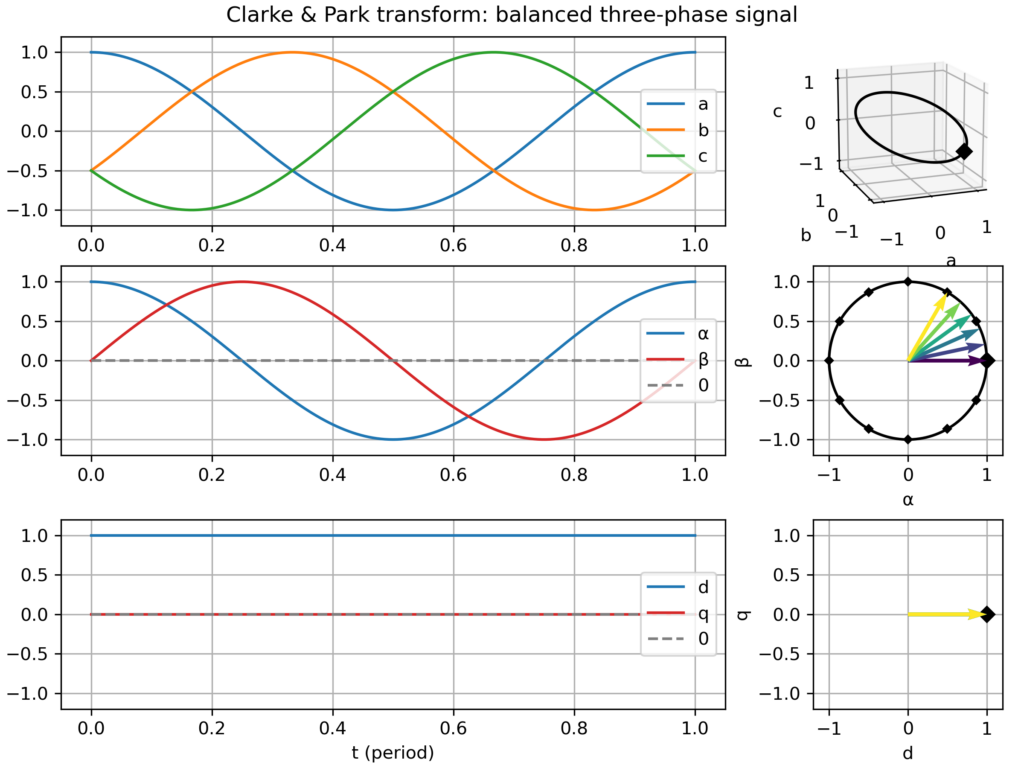
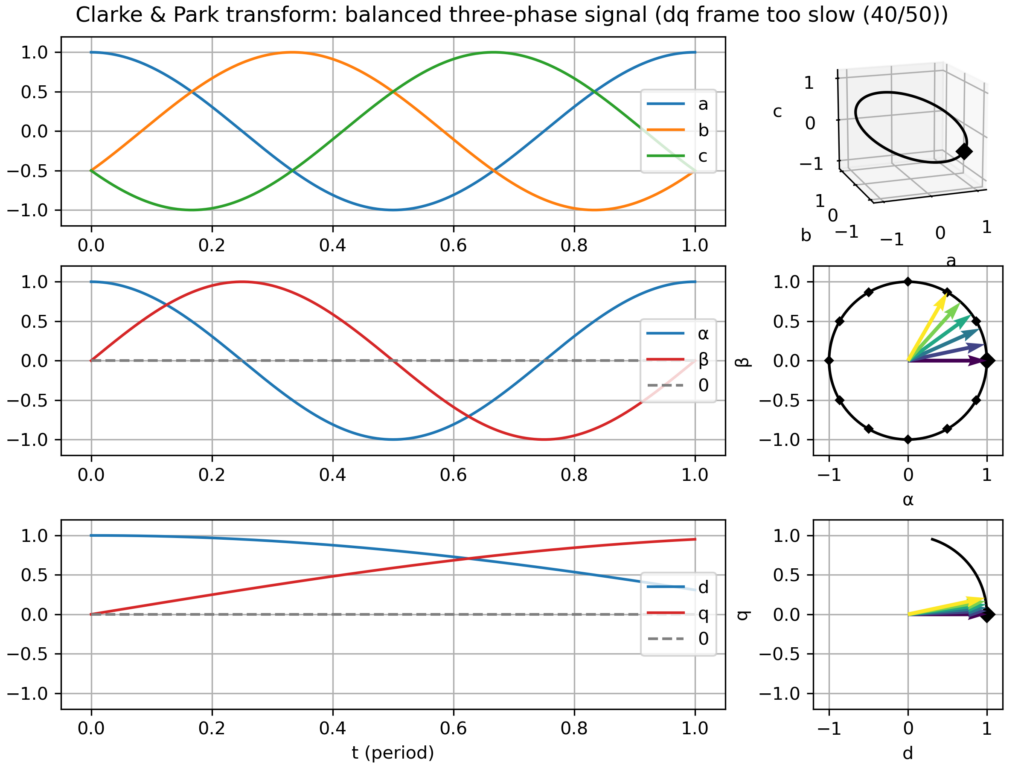
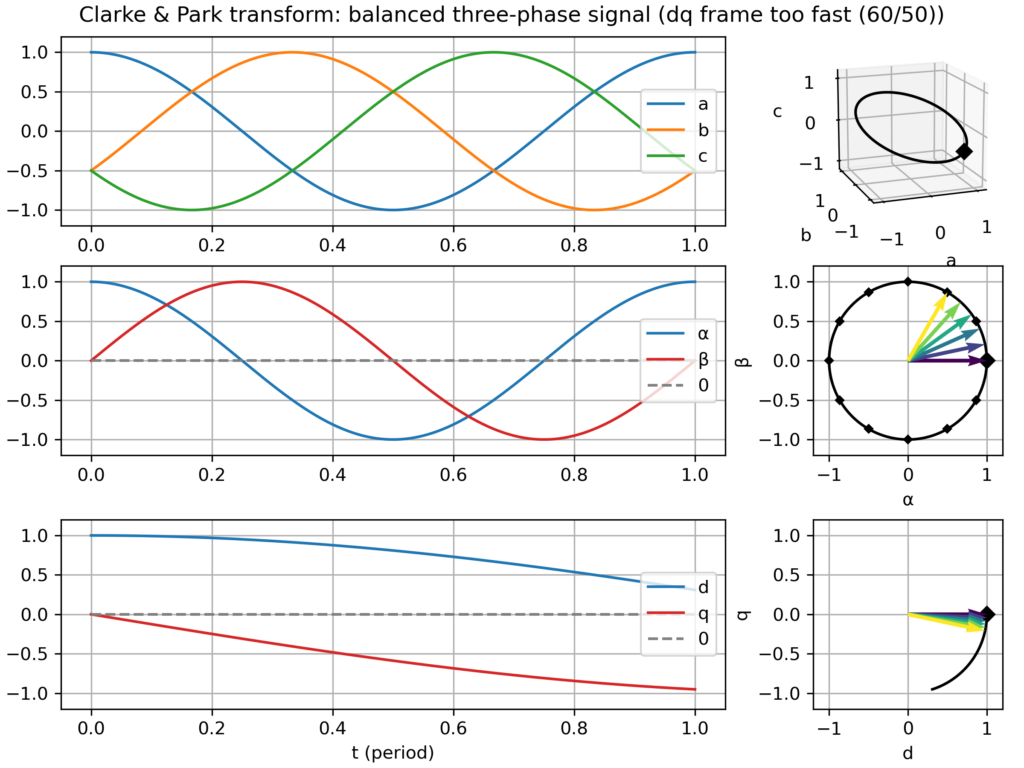
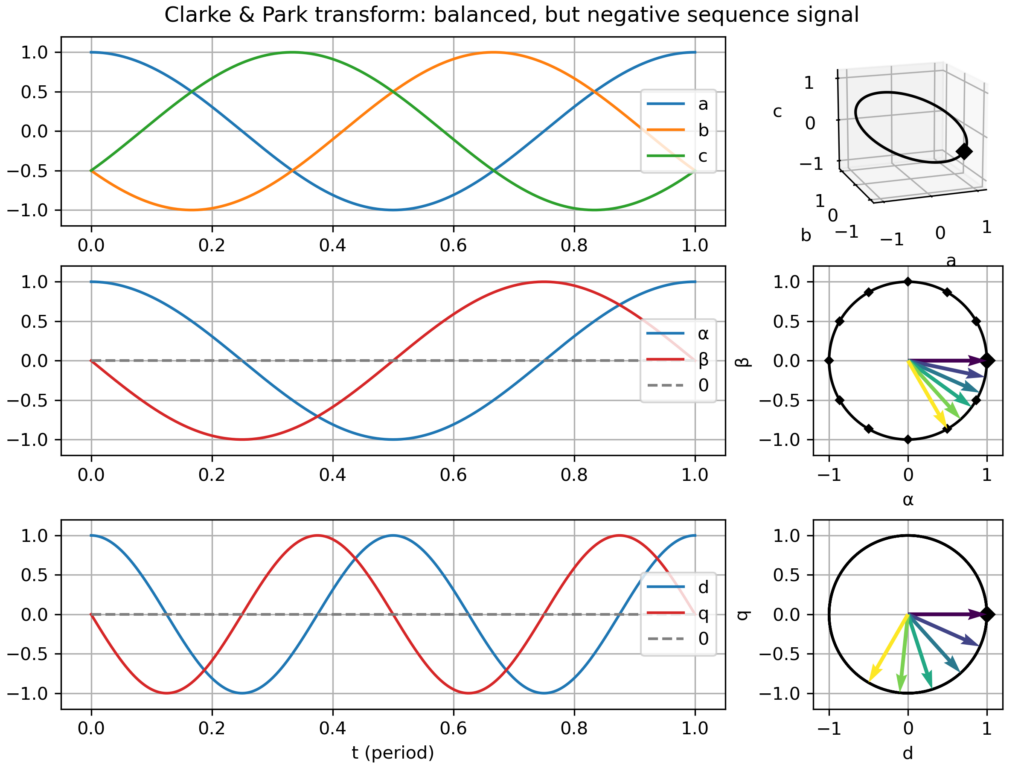
The goal is to “look beyond the math” (beyond the matrices-based definitions) to witness how the different transformations relate to each other (i.e. Park = Clarke + Rotation(−ω.t)) and how different signals get transformed. The plot I created assembles:
- time domain plots in the natural (abc), Clarke (αβ) & Park (dq) frames over one electric period
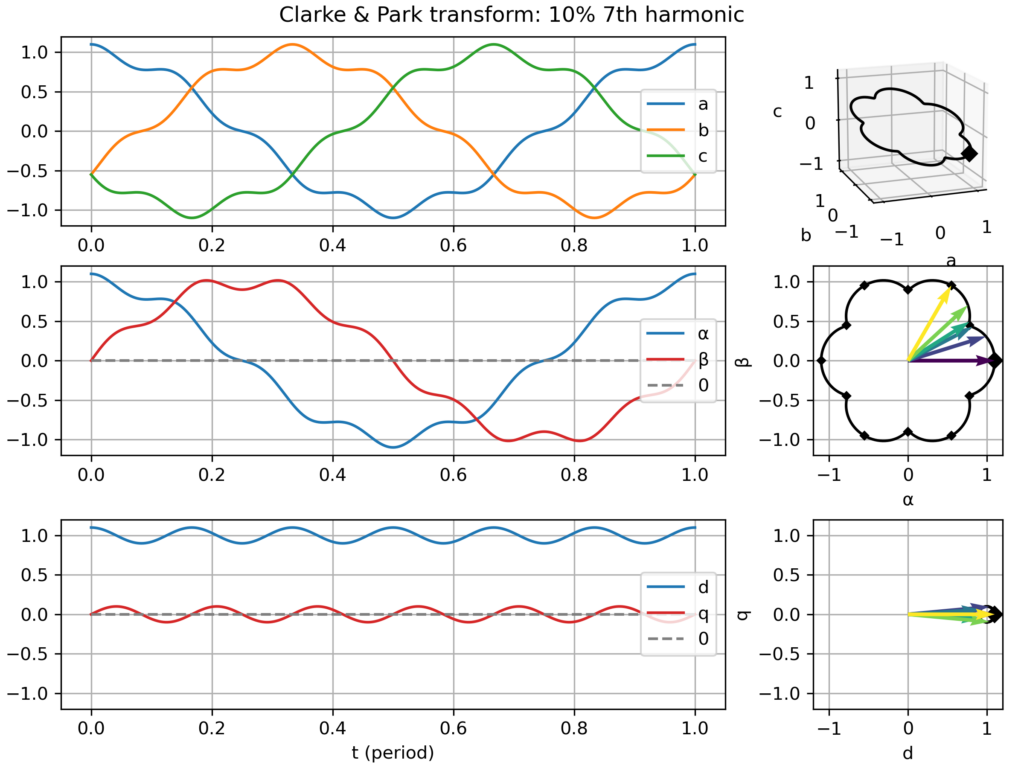
- a corresponding plot in the space vector domain (i.e. parametric curve), either in the hard-to-see 3D abc frame, and in the much clearer Clarke (αβ) & Park (dq) frames, where nice 2D geometric figures appear (only a "boring circle" for a balanced three-phase signal, but nice snowflake-like patterns appear with 5th or 7th harmonics!)
Transforms gallery
In particular, I saved a series of plots for the following cases:
- Balanced three-phase signal
- nominal case: speed of the dq frame perfectly matching the signal frequency → perfect circular movement in the αβ plane and static vector in the dq plane
- dq frame slightly too slow or too fast → slowly varying vector in the dq plane
- negative sequence signal (i.e. negative frequency −ω) → fast varying vector in the dq plane (−2ω apparent frequency)
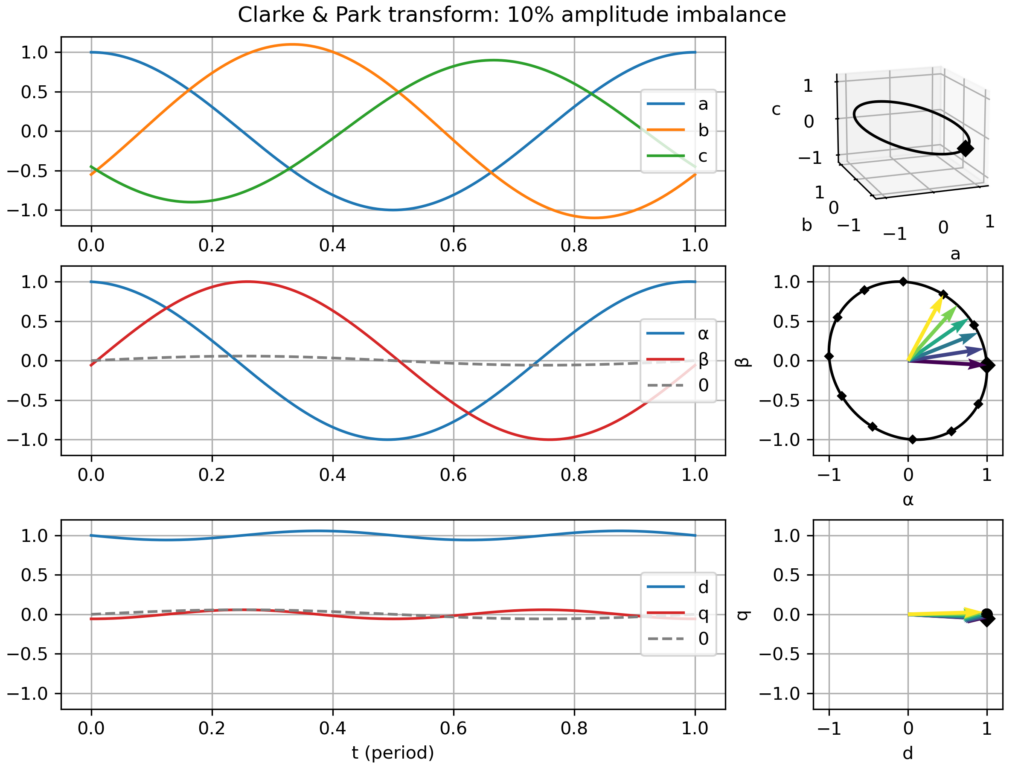
- Unbalanced signal: slight amplitude differences across the three-phases → elliptical (slightly flattened circle) movement in the αβ plane → small −2ω fluctuations in the dq plane
- Balanced signal, but with harmonics (2nd, 3rd, 5th or 7th) → the effect depends on the harmonics:
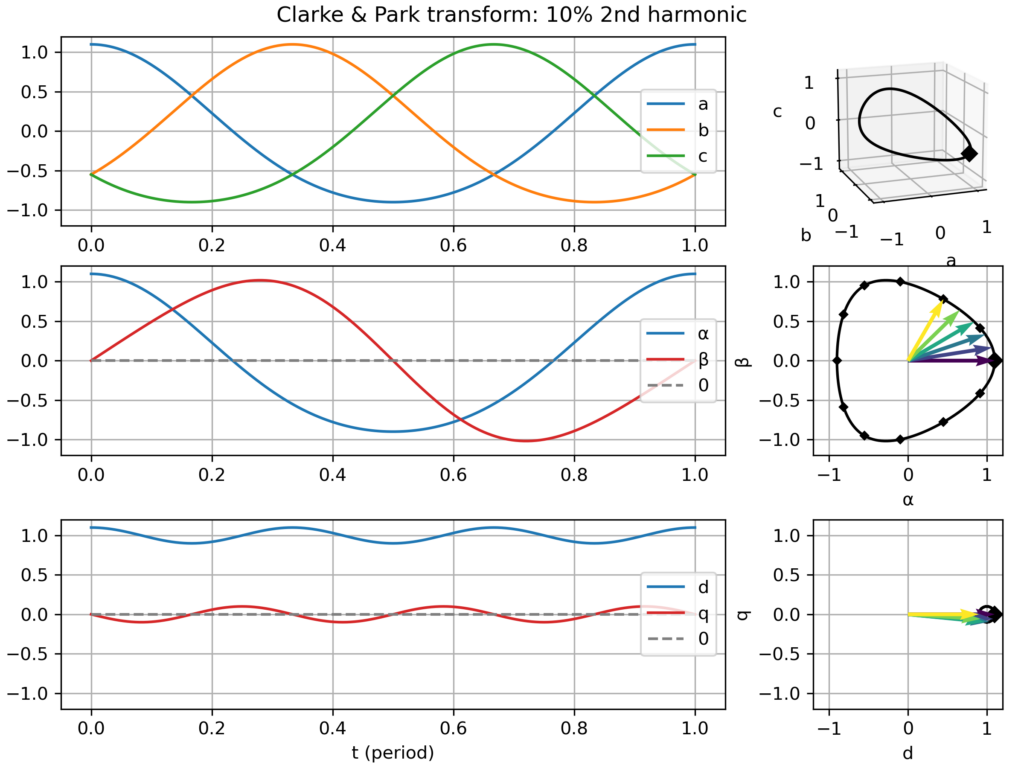
- 2nd harmonic → slightly triangular movement in the αβ plane → small −2ω fluctuations in the dq plane
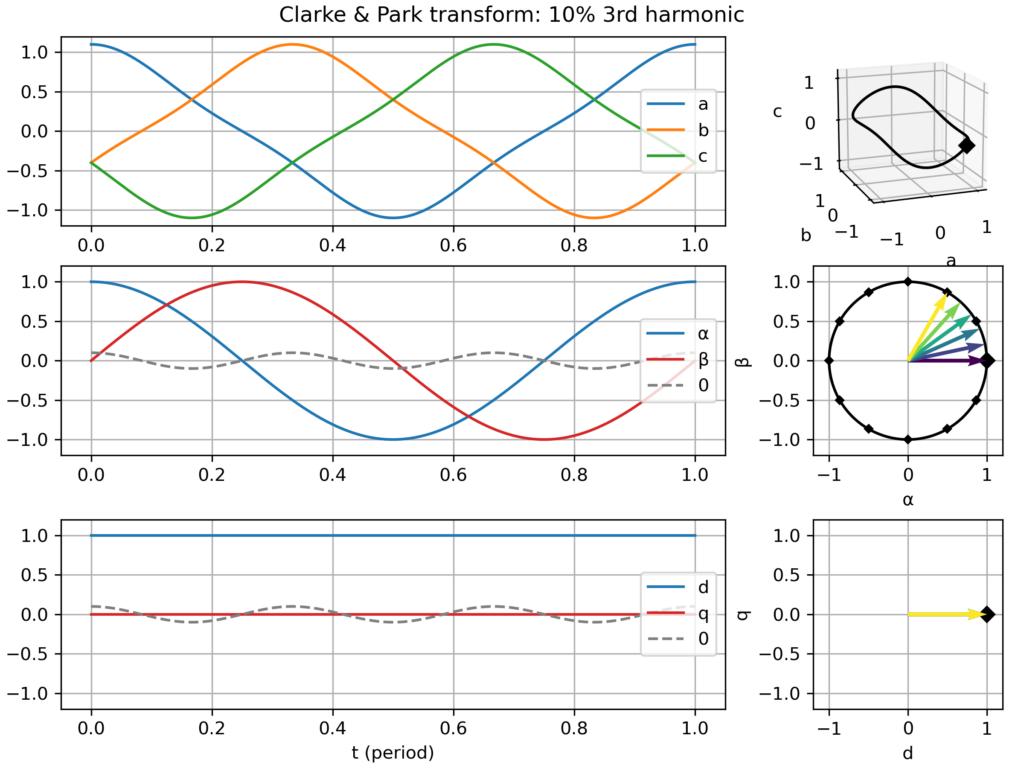
- 3rd harmonic: only create a 0-component (homopolar) → no effect in the αβ plane and in the dq plane
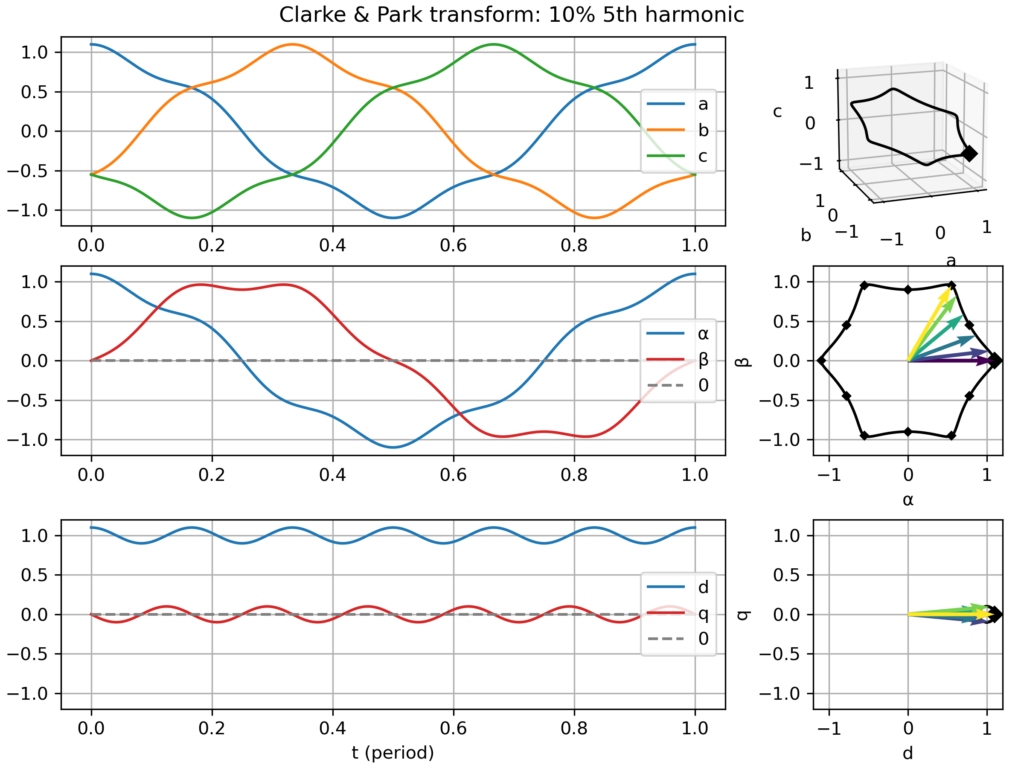
- 5th harmonic: slightly hexagonal movement in the αβ plane → small −6ω fluctuations in the dq plane
- 7th harmonic: slightly hexagonal movement in the αβ plane → small +6ω fluctuations in the dq plane
Explanation for the similar effect of the 5th and 7th harmonic: the former is negative sequence (−5ω) while the latter is positive sequence (+7ω), so from the point of view of the +1ω rotating dq frame, they all appear as 6ω fluctuations. However, this similarity only holds in absolute value, but in truth they are of opposite frequency.
Links
- interactive version of the notebook: https://github.com/pierre-haessig/pierre-notebooks
- download of the notebook: https://github.com/pierre-haessig/pierre-notebooks/blob/main/content/Clarke_Park-dq_transforms_plot.ipynb
